How to choose an online quran academy is an important question for parents and adults who want reliable Quran education through the internet. With many learning options available, selecting a suitable academy requires more than comparing monthly fees or browsing attractive websites.
The right choice should depend on the learner’s age, current Quran reading ability, educational goals, and preferred teaching approach. For example, a child learning Arabic letters needs different guidance from an adult who wants to improve Tajweed or memorize longer Surahs.
Furthermore, online Quran education involves several factors that influence the learning experience. Teacher qualifications, curriculum organization, individual attention, lesson scheduling, and progress assessment all deserve careful consideration.
However, not every academy that advertises qualified teachers or flexible classes provides the same educational experience. Therefore, families should examine the actual teaching process before making a commitment.
This guide explains how to choose an online quran academy using practical criteria, important questions, and realistic learning situations. It also explores common mistakes, warning signs, and ways to evaluate whether an academy matches your educational expectations.
The goal is not simply to find an academy with attractive offers. Instead, it is to identify a learning environment that supports accurate Quran reading, consistent practice, and meaningful educational progress.
Why Knowing How to Choose an Online Quran Academy Matters?

Choosing an appropriate learning environment can influence how confidently students approach Quran education. Although online lessons make learning more accessible, their effectiveness still depends on teaching quality and student participation.
For this reason, families should understand what makes an academy suitable before enrolling.
Building a Strong Foundation in Quran Reading
Beginners need more than opportunities to repeat Arabic words. They must gradually understand letter recognition, pronunciation, vowel marks, and basic reading rules.
A suitable learning program should introduce these skills in a logical order. Otherwise, students may develop pronunciation habits that become difficult to correct later.
For example, a beginner who struggles with similar Arabic sounds may need additional exercises before moving to longer Quranic passages.
Consequently, selecting an appropriate Online Quran Academy can help learners follow a structured educational path rather than studying unrelated lessons.
Developing Correct Quran Recitation
Reading the Quran accurately requires attention to pronunciation and Tajweed principles. Students must learn how letters are articulated and how specific recitation rules apply within Quranic words. Moreover, recognizing a Tajweed rule is different from applying it correctly during recitation.
A qualified teacher should therefore listen carefully, identify mistakes, explain the relevant rule, and provide opportunities for correction.This approach makes individual feedback an important consideration when evaluating online Quran education.
Maintaining Consistent Learning Habits
Regular practice is essential for developing Quran reading and memorization skills. Nevertheless, students may struggle to maintain a routine when lessons conflict with school, work, or family responsibilities.
A suitable schedule can make learning easier to maintain over time. Additionally, realistic lesson targets help students avoid unnecessary pressure.
When considering how to choose an online quran academy, families should examine whether its scheduling arrangements support long-term consistency.
Start Your Quran Learning Journey with Online Quran Academy
Are you ready to improve your Quran reading, pronunciation, and Tajweed skills? Choosing a suitable learning program can make your journey more organized and rewarding. Online Quran Academy provides an opportunity to explore online Quran learning according to your educational needs and personal goals.
Whether you are a beginner, an adult returning to Quran study, or a parent seeking lessons for your child, the right learning approach matters. Contact Online Quran Academy today to ask about available courses, teacher arrangements, lesson schedules, and teaching methods.
Take the first step toward more accurate Quran reading and greater confidence in recitation. Start exploring your learning options today!

How to Choose an Online Quran Academy? 10 Essential Factors
There is no single feature that determines whether an academy is suitable for every learner. Instead, several educational and organizational factors should be evaluated together.
The following criteria provide a practical framework for comparing available options.
1. Check Teacher Qualifications When Choosing an Online Quran Academy
Teacher qualifications should be among your first considerations. A teacher may recite beautifully, but effective instruction also requires the ability to explain Quranic concepts clearly.
Therefore, examine both religious qualifications and actual teaching experience.
Important points to investigate include:
- Quranic qualifications: Ask about relevant studies, certifications, and Ijazah when applicable.
- Tajweed knowledge: Check whether the teacher understands pronunciation rules and their practical application.
- Teaching experience: Consider experience with children, adults, or beginners according to your needs.
- Communication skills: The teacher should explain mistakes in language the learner understands.
- Correction techniques: Observe whether feedback is clear, respectful, and educational.
Furthermore, ask what qualifications apply to the specific teacher who will conduct your lessons. General statements about an academy’s teaching staff do not necessarily establish the background of every instructor.
An experienced teacher should also recognize when a student needs additional practice rather than introducing new material too quickly.
When evaluating how to choose an online quran academy, remember that teaching ability matters alongside formal qualifications.
2. Evaluate the Curriculum of an Online Quran Academy
A clear curriculum helps students understand what they will study and how lessons develop over time.Without an organized learning plan, students may repeatedly study familiar material without addressing important weaknesses.
Before enrolling, investigate whether the curriculum includes:
- Arabic letter recognition for beginners.
- Correct pronunciation and articulation points.
- Noorani Qaida or another suitable introductory method.
- Quran reading fluency.
- Essential Tajweed rules.
- Quran memorization and revision when required.
- Regular reading practice and correction.
However, not every learner needs all these subjects simultaneously.
For instance, a child who cannot recognize Arabic letters should generally establish that foundation before beginning advanced Tajweed lessons.
Similarly, an adult who already reads fluently may benefit more from detailed recitation correction than introductory alphabet exercises.
Ask for a clear explanation of the learning stages. You should understand the starting level, expected lesson content, and how the teacher decides when to introduce more advanced material.
This is one of the most useful ways to assess an Online Quran Academy because it reveals whether instruction follows an educational plan or depends entirely on individual lessons.
3. Choose the Right Online Quran Academy Lesson Format
Lesson format can significantly influence the amount of attention each student receives. Some learners benefit from private instruction, while others enjoy studying alongside classmates. Therefore, the best arrangement depends on individual preferences and educational needs.
Individual lessons
Private lessons generally allow the teacher to focus on one learner throughout the session. Potential advantages include:
- More opportunities for individual recitation.
- Immediate correction of pronunciation mistakes.
- Lessons adjusted to the student’s current level.
- Greater flexibility when addressing specific difficulties.
- A learning pace based on individual progress.
For example, a beginner who repeatedly confuses two Arabic letters may need several focused exercises. Individual instruction can provide more opportunities to practice these sounds.
Group lessons
Group classes offer a different learning environment. Students may benefit from listening to other learners, participating in shared activities, and developing confidence through interaction. Nevertheless, the amount of individual correction may depend on class size and lesson organization.
Before choosing, ask:
- How many students attend each lesson?
- Does every student receive individual recitation time?
- How does the teacher correct mistakes?
- Can students ask questions during the session?
Ultimately, do not assume that private or group lessons are automatically better. Compare the format with the learner’s age, confidence, and educational objectives.
4. Find an Online Quran Academy That Matches Your Level
Students begin Quran education with different abilities. Some recognize Arabic letters but struggle with connected words, whereas others read fluently but need better Tajweed application.
Therefore, an academy should understand the learner’s starting point before recommending a suitable program. Beginners may benefit from tajweed classes for beginners that introduce essential recitation rules gradually.
A basic assessment may examine:
- Recognition of Arabic letters.
- Understanding of short and long vowels.
- Ability to connect letters within words.
- Reading fluency.
- Pronunciation difficulties.
- Existing knowledge of Tajweed.
- Previous memorization, if relevant.
Afterward, the teacher can identify which skills require attention. For example, an adult returning to Quran study after several years may remember the Arabic alphabet but struggle with reading speed and pronunciation.
In this situation, immediately assigning advanced recitation lessons may create unnecessary difficulty. Instead, an appropriate starting assessment can identify the skills that need revision before introducing more challenging material.
Learners who want to strengthen their reading foundations can also explore the best way to learn quran according to their current abilities.
This consideration is particularly important when deciding how to choose an online quran academy for learners with different educational backgrounds.
5. Check Online Quran Academy Scheduling Options
Flexible scheduling is valuable because online Quran students often live in different countries and time zones. Parents may prefer lessons after school, while working adults may need evening or weekend appointments. However, advertised flexibility should be examined carefully.
Ask the academy about:
- Available lesson times in your local time zone.
- Options for changing scheduled lessons.
- Procedures for missed classes.
- Holiday arrangements.
- Whether a regular weekly schedule is possible.
- How schedule changes are communicated.
Additionally, consider the learner’s ability to concentrate during the proposed lesson time. A child attending a Quran class immediately after a long school day may feel tired. Similarly, an adult studying late at night may find it difficult to maintain attention.
Parents comparing educational options for their children may also consider the best online Arabic classes for kids when evaluating suitable learning schedules.
Therefore, choose a schedule that allows sufficient preparation, concentration, and revision. An Online Quran Academy should explain its scheduling arrangements clearly so families can make realistic decisions.
6. Evaluate Student Progress in an Online Quran Academy
Progress monitoring helps learners understand which skills they have developed and which still require attention. Without useful feedback, students may continue attending lessons without knowing whether their reading accuracy or Tajweed application is improving.
A practical progress system may include:
- Notes about completed lessons.
- Identification of repeated pronunciation mistakes.
- Regular reading assessments.
- Memorization and revision records.
- Teacher recommendations for additional practice.
- Clear learning targets for upcoming sessions.
For children, parents may also need updates about attendance, participation, and areas requiring additional home practice.
However, progress should not be judged only by the number of pages completed. A student who reads fewer verses accurately may demonstrate stronger learning than someone who reads several pages while repeating the same mistakes.
Learners who prefer independent revision can explore practical guidance on how to memorize quran at home. Those seeking a more structured memorization path may also review the hifz course online.
Consequently, ask how teachers evaluate accuracy, fluency, and understanding rather than relying exclusively on lesson completion.
When assessing how to choose an online quran academy, prioritize meaningful feedback over impressive-looking progress charts.
7. Check Communication and Support Before Choosing an Online Quran Academy
Effective communication supports a more organized learning experience. Parents need to understand their children’s educational needs, while adult learners should feel comfortable asking questions about their lessons.
Before enrolling, consider the following:
- Is there a clear channel for contacting the academy?
- Can parents ask about their child’s progress?
- Are lesson changes communicated promptly?
- Can students request clarification about difficult topics?
- Is there a process for reporting teaching concerns?
Furthermore, observe how the academy responds before enrollment. Clear answers, respectful communication, and realistic explanations can help establish reasonable expectations.
On the other hand, unclear responses about lesson arrangements or educational responsibilities may indicate that you need additional information before committing.
8. Compare Online Quran Academy Pricing and Payment Conditions
Price is an important consideration, but the cheapest option is not necessarily the most suitable. Two academies may advertise similar monthly fees while offering different lesson lengths, class formats, and teaching arrangements. Therefore, compare the complete service rather than the headline price.
| Pricing factor | What you should check |
|---|---|
| Monthly fees | Total amount payable |
| Lesson duration | Actual teaching minutes |
| Weekly frequency | Number of lessons included |
| Registration fees | Any additional enrollment charges |
| Missed lessons | Rescheduling or makeup arrangements |
| Cancellation | Conditions for ending enrollment |
| Payment methods | Available payment options |
For example, a lower monthly fee may include shorter lessons. Another option may offer longer sessions but require fewer weekly classes.
Consequently, calculate the approximate cost per lesson and compare the educational arrangements. Also, request written payment and cancellation conditions before making a financial commitment.
A trustworthy enrollment process should make these details understandable without pressuring families into purchasing long-term packages immediately.
9. Why Trial Lessons Matter When Choosing an Online Quran Academy
A trial lesson gives students and parents an opportunity to evaluate the teaching experience before making a longer commitment. However, the value of a trial depends on what actually happens during the session. A useful trial should provide an opportunity to:
- Meet the teacher who may conduct future lessons.
- Discuss the learner’s current Quran reading ability.
- Observe how the teacher explains unfamiliar concepts.
- Receive feedback about pronunciation or reading difficulties.
- Understand the proposed learning approach.
- Ask questions about scheduling and lesson organization.
Additionally, pay attention to how the teacher interacts with the student. Does the teacher allow enough time for questions? Are mistakes corrected patiently? Can the student understand the explanations?
These observations provide more useful information than simply receiving a general statement that the learner performed well. Before booking, confirm whether the trial is free, how long it lasts, and whether any payment information is required.
Remember: A trial lesson is an opportunity to evaluate educational compatibility, not a guarantee of future results.
10. Evaluate the Technology Used by an Online Quran Academy
Technology plays an important role in Quran education because lessons depend on stable communication between teachers and students.
Even a qualified teacher may struggle to explain pronunciation when audio quality is poor, or the connection repeatedly disconnects. Therefore, examine the technical arrangements before selecting an academy.
Consider these practical requirements:
- A stable internet connection.
- Clear microphone and speaker quality.
- A suitable video communication platform.
- A quiet learning environment.
- Screen-sharing capabilities when educational materials require them.
- Access to digital learning materials when provided.
- Technical support when connection problems occur.
For children, parents should also check whether the device is positioned appropriately and whether the student can see the teacher’s mouth movements when pronunciation demonstrations are needed.
Furthermore, ask what happens when technical problems interrupt a scheduled lesson.Does the academy provide another appointment? Is the missed time handled according to a written policy? These details matter because technical difficulties should not repeatedly interrupt the student’s educational routine.
How to Choose an Online Quran Academy for Children?
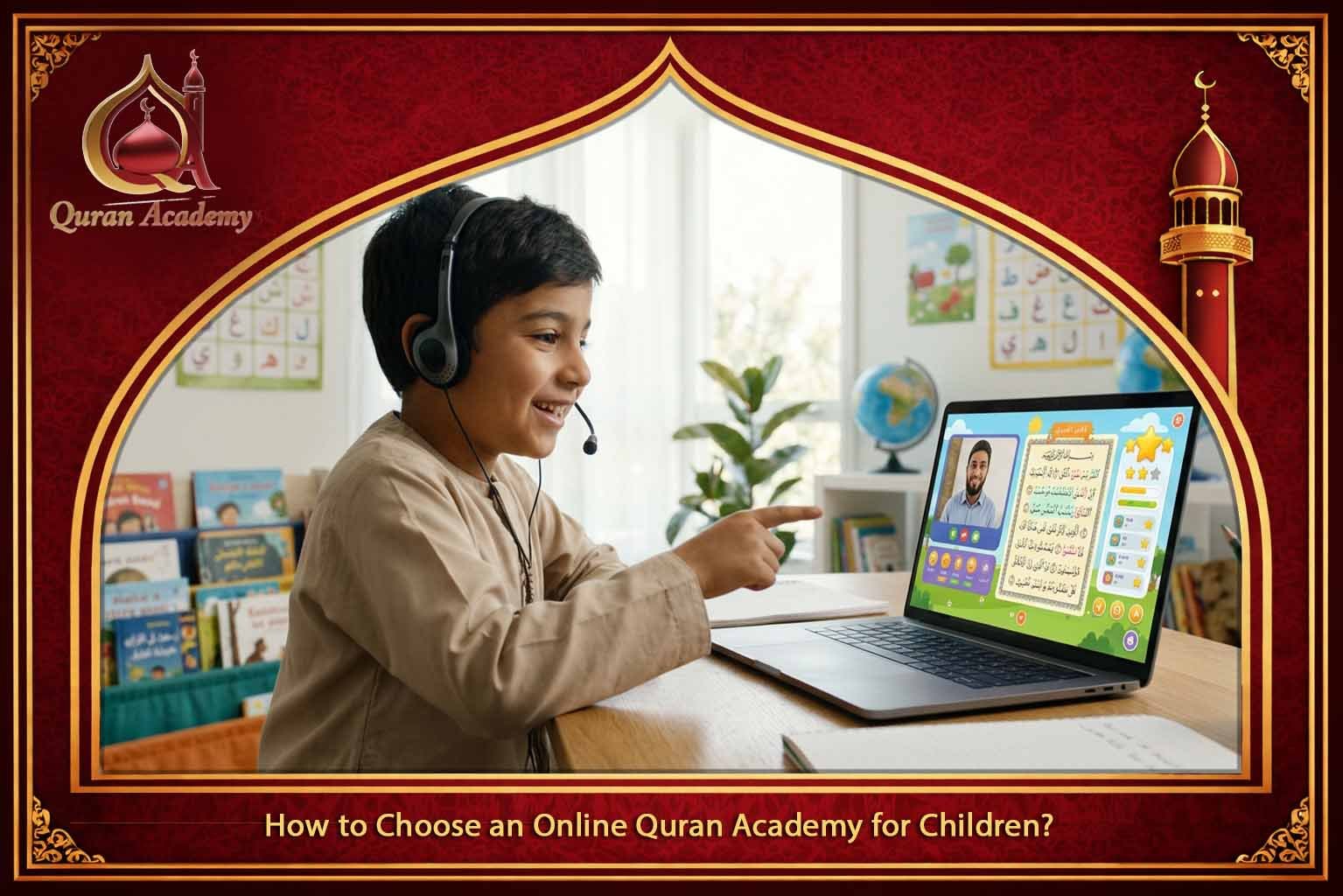
Children need an educational environment that considers their age, attention span, reading ability, and emotional comfort. For this reason, parents should evaluate more than the advertised subjects or lesson prices.
Choose Teachers Experienced in Teaching Children
Teaching children requires patience and an understanding of how young learners develop new skills. A teacher should be able to explain unfamiliar Arabic sounds using simple language and age-appropriate examples. Moreover, younger students may need shorter activities and frequent opportunities to participate.
During a trial lesson, observe whether the teacher:
- Explains instructions clearly.
- Encourages the child to participate.
- Corrects mistakes without embarrassment.
- Uses suitable learning activities.
- Adjusts the pace when the child struggles.
- Maintains a respectful teaching environment.
A child who feels comfortable asking questions may become more willing to practice independently.
Check Child Safety and Parent Involvement
Online education requires parents to consider digital safety alongside teaching quality. Before enrollment, ask who can access the online classroom and how communication between teachers and children is managed.
Important questions include:
- Can parents observe their child’s lessons?
- Who is permitted to communicate with the child outside class?
- Are there clear rules for teacher-student communication?
- How are personal information and lesson recordings handled?
- Who should parents contact if a concern arises?
Additionally, ask whether lessons are recorded and, if so, how recordings are stored and accessed. Recording policies should explain who can view the material, how long it remains available, and whether parental consent is required.
These precautions help parents make informed decisions about their children’s online learning environment.
Consider Whether Female Teachers Are Available
Some families prefer female Quran teachers for their daughters, particularly when children become older. Similarly, adult women may prefer studying with female instructors.
If teacher gender is important to your family, ask about availability before enrollment rather than assuming that a suitable teacher can always be assigned. Also, confirm whether the teacher can accommodate the learner’s language needs and educational level.
The important consideration is finding an instructor who combines suitable qualifications with an appropriate teaching approach.
How to Choose an Online Quran Academy for Adults
Adults often approach Quran education with different expectations from children. Some want to correct long-standing pronunciation mistakes, while others are returning to Quran reading after an extended break. Meanwhile, experienced readers may want to study advanced Tajweed or begin a memorization program.
Identify Your Main Learning Objective
Before comparing academies, decide what you want to achieve. Your objective should influence the course, teacher, and lesson structure you select.
| Learning objective | What to look for |
|---|---|
| Learning Quran from the beginning | Arabic letters and basic reading instruction |
| Improving recitation | Individual pronunciation correction |
| Studying Tajweed | Structured lessons and practical application |
| Memorizing Quran | Memorization targets and revision plans |
| Improving fluency | Regular reading practice and feedback |
| Returning to Quran study | Assessment and revision of previous knowledge |
For example, an adult who already reads Arabic does not necessarily need to begin with introductory alphabet lessons.
Instead, an initial assessment may reveal that the main challenge involves articulation points or applying Tajweed rules consistently.
Look for a Realistic Study Schedule
Adults may balance Quran learning with employment, family responsibilities, and other commitments. Consequently, a realistic schedule is more valuable than an ambitious plan that becomes difficult to maintain. Before enrolling, consider:
- How many lessons can you attend each week?
- When can you revise independently?
- How much time can you dedicate to memorization?
- Do you need evening or weekend appointments?
- Would shorter, frequent sessions suit your routine?
Furthermore, discuss your available study time with the teacher. A suitable learning plan should reflect your actual circumstances rather than assuming that every adult can follow the same timetable.
Consider Your Preferred Learning Pace
Adults should feel comfortable explaining when a lesson moves too quickly or requires additional practice. For instance, a student learning Tajweed may understand a rule theoretically but struggle when applying it during continuous recitation.
In this situation, repeating selected examples can be more beneficial than immediately introducing another rule. When deciding how to choose an online quran academy, consider whether the teaching approach allows sufficient time for practice and correction.
Practical Learning Scenarios for Online Quran Academies
The following scenarios illustrate common learning needs among children and adults and highlight what to consider when choosing an online Quran academy.
Experience 1: A Child Struggling With Arabic Pronunciation
Imagine a child who recognizes most Arabic letters but repeatedly confuses two similar sounds during Quran reading. Initially, the child may become frustrated because the same mistake appears in different words.
During a trial lesson, the parent observes how the teacher responds to this difficulty. Instead of moving immediately to a new lesson, the teacher identifies the pronunciation problem and provides several focused examples.
The child then repeats the sounds, listens to the correction, and practices them within simple words. After the lesson, the parent asks what the child should practice before the next session.
This situation demonstrates why evaluating the teaching process is more useful than judging an academy by its website or promotional claims.
A suitable teacher should recognize the learner’s difficulty, explain the correction, and provide an appropriate practice task.
Experience 2: An Adult Returning to Quran Learning
Consider an adult who learned Quran reading during childhood but stopped practicing regularly for several years. Although the student remembers Arabic letters, reading connected words feels slower than expected.
The student initially considers joining an advanced Tajweed program. However, an introductory assessment reveals that basic reading fluency needs attention first. The teacher recommends reviewing selected reading skills before progressing to more detailed recitation rules.
Consequently, the student begins with manageable exercises and gradually increases the difficulty of the material. This example highlights an important lesson: the right starting point matters more than choosing the most advanced course.
When evaluating how to choose an online quran academy, look for an approach that respects your current ability and educational priorities.
How to Compare Online Quran Academy Options Before Enrollment?

After reviewing the educational criteria, compare the academies using the same questions. This prevents attractive marketing messages or low prices from influencing your decision without sufficient evidence. The following checklist can help organize your evaluation.
| Evaluation factor | What a suitable option should demonstrate |
|---|---|
| Teacher qualifications | Clear information about relevant credentials |
| Teaching experience | Experience with your age and learning level |
| Curriculum | Organized subjects and learning stages |
| Initial assessment | A clear understanding of your starting level |
| Lesson format | Transparent individual or group arrangements |
| Progress tracking | Useful feedback and learning targets |
| Scheduling | Practical lesson times |
| Communication | Clear channels for questions and support |
| Trial lesson | An opportunity to evaluate actual teaching |
| Pricing | Understandable fees and written conditions |
| Child safety | Clear supervision and communication policies |
| Technology | Reliable arrangements for online instruction |
You can also score each academy from one to five for every factor.
However, do not treat the total score as the only deciding factor. Some considerations, such as teacher qualifications and child safety, may be more important than scheduling convenience. Therefore, discuss any unanswered questions before making your final decision.
Questions to Ask When Choosing an Online Quran Academy
A website may provide general information about courses, but direct questions can reveal important details that are not immediately visible. Before paying, prepare a short list of questions and request clear answers.
Teacher Qualifications and Experience
- What qualifications does the assigned teacher hold?
- How much experience does the teacher have with my age group?
- Is it possible to request a male or female teacher?
- Which methods does the instructor use to identify and correct recitation mistakes?
Lesson Structure and Learning Materials
- Are lessons individual or shared with other students?
- What is the duration of each session?
- Which learning materials are included?
- Can the lesson plan be adjusted according to student progress?
Student Progress and Performance
- How frequently does the academy review student progress?
- Will I receive feedback after each lesson?
- What steps are taken to address recurring pronunciation mistakes?
- Which criteria determine when a student is ready for the next level?
Enrollment Costs and Payment Policies
- What is the total monthly cost?
- Do additional registration fees apply?
- What arrangements are available if a student misses a lesson?
- Under what conditions can enrollment be cancelled without extra charges?
Obtaining clear answers makes it easier to compare different learning options before making a commitment. Additionally, reviewing the academy’s payment and attendance policies can help prevent misunderstandings later.
Common Mistakes When Choosing an Online Quran Academy
Even when families understand the importance of Quran education, certain mistakes can lead to unsuitable enrollment decisions. Recognizing these problems beforehand makes the selection process easier.
Choosing an Academy Based Only on Price
Low prices may appear attractive, particularly when families need lessons for several children. Nevertheless, monthly fees do not reveal lesson duration, teaching arrangements, or the amount of individual attention available. Compare the complete educational service before deciding.
Assuming Every Certified Teacher Has the Same Qualifications
The word “certified” can refer to different educational backgrounds and qualifications. Therefore, ask what the certificate represents and whether it relates to Quran recitation, Tajweed, memorization, or another subject. Where relevant, request details about the teacher’s Ijazah and the recitation in which it was granted.
Ignoring the Initial Assessment
Starting lessons without understanding the student’s current ability can result in an unsuitable learning plan. For instance, a beginner may struggle with advanced Tajweed concepts before developing basic reading skills. A proper assessment helps prevent this mismatch.
Enrolling Without Trying the Teaching Method
A teacher may have strong qualifications but use an approach that does not suit a particular learner. Therefore, evaluate the teacher’s explanations, correction methods, communication, and ability to maintain student participation.
Expecting Immediate Results
Quran reading, Tajweed, and memorization require regular practice. Progress differs according to the learner’s starting level, available study time, and consistency.
Be cautious of promises that guarantee memorization within a specific period without considering individual circumstances.
Overlooking Enrollment and Cancellation Conditions
Some families focus on the first payment without examining the complete terms. However, missed lessons, rescheduling, refunds, and cancellation arrangements can influence the overall experience. Always request written clarification before committing to a long-term package.
Warning Signs When Choosing an Online Quran Academy
Knowing what to avoid is just as important as understanding what to look for. Although no single warning sign automatically proves that an academy provides poor education, repeated problems deserve attention. Watch for the following situations:
- The academy refuses to explain teachers’ relevant qualifications.
- Course descriptions provide no clear learning objectives.
- The assigned teacher changes frequently without explanation.
- Students receive little opportunity to practice recitation.
- Questions about fees or cancellation policies receive unclear answers.
- The academy guarantees unrealistic memorization results.
- Parents cannot understand who supervises children’s lessons.
- Technical difficulties repeatedly interrupt classes without a clear solution.
- The academy pressures families to purchase expensive packages immediately.
- Advertised private lessons turn out to involve additional students.
- Furthermore, examine independent reviews when available.
Look for detailed comments describing teaching quality, communication, and the learning experience rather than relying exclusively on general positive statements.
A balanced evaluation should consider both positive feedback and recurring concerns.
How to Choose the Best Online Quran Academy for Your Needs?
After comparing the available information, narrow your choices to the options that meet your most important requirements.
Instead of making a decision immediately, follow a simple evaluation process.
- Step 1: Define your educational goal.
Decide whether you need Quran reading, Tajweed, memorization, or introductory Arabic instruction. - Step 2: Establish your starting level.
Identify the learner’s existing abilities and the areas that require improvement. - Step 3: Review teacher qualifications.
Ask for specific information about the instructor’s relevant knowledge and teaching experience. - Step 4: Examine the curriculum.
Make sure the proposed lessons follow an understandable educational structure. - Step 5: Attend a trial lesson.
Observe the teaching approach and evaluate whether the learner feels comfortable. - Step 6: Compare practical arrangements.
Review lesson times, duration, pricing, missed-class policies, and communication. - Step 7: Make an informed choice.
Select the option that best matches your educational needs, budget, and expectations.
This process makes choosing an academy less dependent on advertising and more focused on verifiable educational considerations.
How to Choose an Online Quran Academy for Long-Term Learning?

The most suitable academy should support a learning routine that students can maintain beyond their first few lessons. Although introductory sessions help establish initial expectations, long-term educational quality depends on consistent instruction and meaningful feedback.
Balance New Lessons With Regular Revision
Students learning Quran memorization need opportunities to review previously learned passages. Without sufficient revision, memorized material may become difficult to recall accurately.
Therefore, ask whether the proposed learning plan includes time for reviewing earlier lessons alongside introducing new material. The balance should depend on the learner’s memorization ability, current workload, and available practice time.
Make Independent Practice Part of the Routine
Online lessons alone cannot replace the student’s own practice. Learners need opportunities to repeat pronunciation exercises, review reading material, and prepare for upcoming sessions.
Parents can support younger children by creating a quiet study environment and encouraging consistent practice. Meanwhile, adults may benefit from setting aside a regular time for independent revision.
Review Learning Goals Periodically
Educational needs may change as students develop new skills. A beginner who initially needs help recognizing Arabic letters may eventually require more advanced reading exercises.
Similarly, a student who begins with basic recitation may later become interested in Tajweed or memorization. Regular discussions with the teacher can help ensure that the learning plan remains appropriate.
Consequently, an Online Quran Academy should be evaluated not only by its introductory lessons but also by how clearly it explains continued learning and development.
Frequently Asked Questions About Choosing an Online Quran Academy
The following frequently asked questions about choosing an online Quran academy address common concerns about teachers, lesson quality, learning methods, and enrollment decisions.
1. How can I know whether an online Quran teacher is qualified?
Ask about the teacher’s Quranic studies, relevant certifications, teaching experience, and Ijazah when applicable. You can also request a short recitation demonstration to evaluate pronunciation and familiarity with Tajweed.
2. How much internet speed is needed for online Quran lessons?
A stable broadband or mobile internet connection is generally sufficient for video lessons. However, reliable audio quality is particularly important because students need to hear pronunciation clearly and receive accurate recitation corrections.
3. Should I choose an academy that provides certificates?
That depends on your educational goals. If you need formal recognition, ask what the certificate represents, who issues it, and whether it confirms attendance, course completion, or a specific qualification.
4. Can siblings study Quran online using the same device?
Yes, siblings can use the same device for their lessons when their schedules allow it. However, separate sessions may provide better opportunities for individual assessment, personalized instruction, and pronunciation correction.
Conclusion
Understanding how to choose an online quran academy requires looking beyond attractive advertisements, low prices, and general promises.
The most important considerations include teacher qualifications, curriculum structure, suitable lesson formats, initial assessments, and meaningful progress monitoring.
Additionally, families should evaluate scheduling arrangements, communication, child safety, technical support, and payment conditions before enrollment.
Whether you are choosing Quran lessons for a child or returning to Quran study as an adult, your decision should reflect your actual educational needs.
Take advantage of trial lessons, ask specific questions, and compare the teaching experience before making a commitment.
Ultimately, the right Online Quran Academy is not simply the one offering the most courses. It is the one whose teaching approach, educational structure, and practical arrangements match your learning goals.
Choose carefully, establish realistic expectations, and maintain a consistent practice routine to make your Quran learning journey more organized and rewarding.