Before a child can sound out a single word of the Quran, they need to recognize the Arabic letters themselves, how each one is written, and how its sound changes depending on its position in a word.
This stage comes before Noorani Qaida and Quran reading, and rushing past it usually shows up later as slow, hesitant recitation. Quran Academy teaches Arabic letters through repetition and simple writing practice, building toward Noorani Qaida once a child knows the alphabet well.
In early childhood, the brain learns best through play, repetition, and daily-life connections, making modern methods more effective than traditional memorization.
Why Kids Need a Special Approach for Arabic Letters
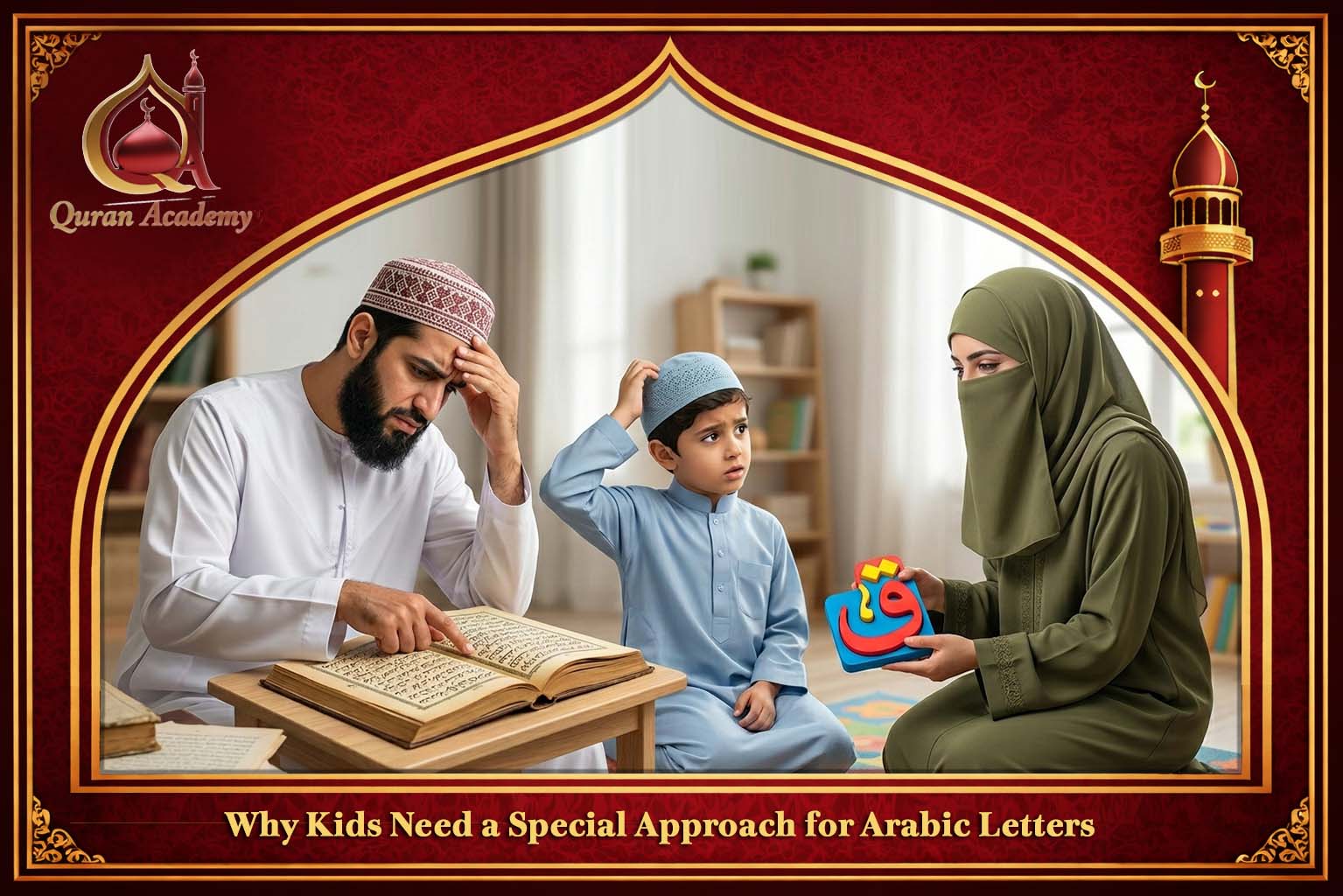
Children do not learn in the same way as adults. Their learning process is naturally different and depends on sensory and emotional engagement rather than logic alone. They rely on:
- Visual learning more than text-based learning
- Sound recognition more than written explanation
- Repetition more than long instruction
- Play-based learning more than formal teaching
Because of these differences, any successful teaching method must adapt to the child’s mindset rather than forcing adult learning techniques onto them.
When learning feels like a game, children respond positively. They participate willingly and retain information more effectively without pressure or stress. This emotional connection is extremely important for long-term retention.
Another key factor is reducing cognitive overload. Introducing all 28 Arabic letters at once can overwhelm a child’s memory capacity. Instead, breaking the alphabet into smaller, manageable groups helps children absorb information gradually and confidently.
Online Quran Academy
quran academy is one of the best choices for learning the Quran online in a simple and structured way suitable for all ages, especially children. It offers well-organized programs that include learning Arabic letters, reading, and Tajweed with qualified teachers and interactive lessons.
quran academy uses modern teaching methods that combine learning with fun, helping students understand quickly and stay motivated. This approach makes the learning experience more effective, flexible, and enjoyable for learners at any level.

The Ideal Step-by-Step Method for Teaching Arabic Letters to Kids
A structured approach is essential for effective learning. The most successful methods divide the Arabic alphabet into clear, progressive stages.
1. Breaking Letters into Small Groups
Instead of presenting all 28 letters at once, they are divided into four structured groups:
- Group 1: Simple and frequently used letters
- Group 2: Visually similar letters
- Group 3: Letters that require careful distinction
- Group 4: Remaining letters with review and reinforcement
This gradual approach allows children to focus on fewer letters at a time, reducing confusion and improving memory retention.Each group is introduced over a short learning cycle, followed by continuous revision of previous groups to strengthen long-term memory.
2. Learning Through Play
Play is one of the most powerful tools in early childhood education. When learning is integrated into fun activities, children naturally engage without resistance.
Effective tools include:
- Flashcards with colorful illustrations
- Educational songs and chants
- Visual matching games
- Letter-to-image association activities
For example, the letter “ب” (Ba) can be associated with the word “butterfly” or “ball,” helping the child connect sound, shape, and meaning at the same time.
This multi-sensory approach significantly improves retention and understanding.
Read also: Noorani Qaida classes for kids
The Importance of Early Arabic Exposure for Kids
Early exposure to Arabic letters for kids is one of the most powerful foundations in shaping a child’s long-term language development. At this early stage, children are not simply learning shapes or sounds; they are actually developing their first cognitive connection with a completely new writing system. The earlier this exposure begins, the more naturally the brain adapts to recognizing Arabic letters, their sounds, and their structure. This makes future stages such as reading, writing, and Quran recitation much easier and more fluid.
In addition, early Arabic learning helps children develop strong auditory discrimination skills, allowing them to distinguish between similar sounds that may seem confusing at first. When this process is supported with repetition, visual aids, and interactive learning methods, children gradually build confidence without feeling pressured. Over time, Arabic becomes familiar rather than foreign, which significantly improves motivation and long-term retention. This is why structured programs like those offered at quran academy focus on early engagement rather than late correction, ensuring that children grow with a natural love for the language.
How Interactive Learning Strengthens Arabic Letter Mastery
Interactive learning has become one of the most effective approaches for teaching Arabic letters for kids because it transforms abstract symbols into meaningful and enjoyable experiences. Instead of relying solely on memorization, children engage with letters through activities such as games, visuals, storytelling, and hands-on exercises. This multi-sensory approach allows different areas of the brain to work together, resulting in stronger memory retention and faster recognition.
For example, when a child hears, sees, and physically traces a letter at the same time, the learning experience becomes deeply embedded in their memory. This method is far more effective than traditional repetition alone. At the Quran Academy, interactive teaching methods are often combined with structured lessons to ensure that children stay engaged while progressing step by step. As a result, children not only learn faster but also develop a positive emotional connection with Arabic learning, which plays a major role in long-term success.
Learning the alphabet is a great first step, and it naturally leads into our Quran classes for kids once a child can recognize the letters with confidence.
Building Strong Learning Habits Through Arabic Letters for Kids
One of the most important outcomes of teaching Arabic letters to kids is the development of strong and consistent learning habits. At an early age, children are highly influenced by routine, repetition, and encouragement. When Arabic learning becomes part of their daily schedule, even for a short period, it helps build discipline and consistency that extends beyond language learning into other areas of life.
Moreover, structured repetition of Arabic letters helps reinforce neural pathways in the brain, making recall faster and more accurate over time. Children begin to recognize patterns, anticipate sounds, and connect letters more naturally. This gradual progression builds both academic ability and emotional stability, as children feel a sense of achievement with every small milestone. Educational platforms like quran academy focus on this gradual development process, ensuring that learning is not rushed but built on strong and lasting foundations.
How Arabic Letters for Kids Lead to Quran Fluency
Learning Arabic letters for kids is not an isolated skill; it is the essential gateway to Quran reading and fluency. Once a child becomes comfortable with the alphabet, they can begin to recognize Quranic words, understand pronunciation rules, and gradually apply Tajweed principles. This step-by-step transition is what transforms basic letter recognition into meaningful Quran recitation.
As children progress, they begin to see how letters form words within real Quranic verses, which strengthens both linguistic and spiritual understanding. This connection creates a deeper appreciation for the Quran and encourages consistent practice. With proper guidance from qualified teachers at a structured quran academy, children are able to move smoothly from basic literacy to confident recitation, building a lifelong bond with the Quran that continues into adulthood.Users can also explore online arabic tutor for kids for more related options.
The Role of Structured Learning Systems in Arabic Education for Kids
Structured learning systems play a vital role in successfully teaching Arabic letters for kids, especially in a modern educational environment where distractions are common. A well-designed curriculum ensures that children progress step by step, starting from simple letter recognition and gradually moving toward reading, writing, and comprehension. This structured approach prevents confusion and ensures that no stage is rushed or skipped.
In addition, structured systems provide continuous feedback, allowing teachers to identify strengths and weaknesses early. This helps tailor lessons according to each child’s learning pace, making the process more personalized and effective. At quran academy, structured learning is combined with interactive methods to create a balanced educational experience that is both engaging and result-oriented. Users can also explore best online arabic classes for kids for more related options.This ensures that children not only learn Arabic letters correctly but also enjoy the learning journey itself.
Practical Activities to Reinforce Arabic Letters for Kids
To ensure effective learning, sensory and hands-on activities should be included regularly. These activities strengthen memory through physical interaction.
Clay Letter Formation
Children form Arabic letters using clay or playdough. This helps them remember the shape of each letter through tactile experience.
Sand or Rice Writing
Letters are drawn in sand or rice trays. This method connects movement with visual recognition and enhances sensory memory.
Air Tracing
Before writing on paper, children trace letters in the air using their fingers. This prepares their motor skills and reinforces shape recognition.
These methods are particularly effective for young learners because they transform abstract shapes into physical experiences.
Distinguishing Similar Arabic Letters
One of the biggest challenges in learning Arabic is distinguishing similar-looking letters such as:
- ب، ت، ث
- ج، ح، خ
- س، ش
- ص، ض
To overcome this difficulty, children must be trained to notice small differences such as dots, placement, and sound variation. Daily comparison exercises help develop strong observational skills, which are essential not only for reading but also for writing accurately. This stage builds attention to detail and strengthens cognitive processing in early learners.
Learning How Letters Form Words
After mastering individual letters, the next step is combining them into words. This is a critical transition from recognition to actual reading.
Children first learn letters in isolation, then progress to understanding their positions:
- Beginning of a word
- Middle of a word
- End of a word
Examples of simple words include:
- باب (door)
- بيت (house)
- كتاب (book)
At this stage, children begin to understand that letters are not separate symbols but connected units that form meaningful words.
Read also: Online Arabic tutor for kids
Age-Based Learning Progression
Different age groups require different teaching strategies.
Ages 2–4: Listening Stage
At this stage, children are not expected to write or even recognize letters. The focus is purely on auditory exposure.
Recommended activities:
- Listening to Arabic alphabet songs
- Hearing simple Arabic words in daily routines
- Passive exposure to sounds
Avoid:
- Writing tasks
- Testing or quizzes
- Long learning sessions
Ages 5–6: Recognition Stage
Children begin recognizing letters visually and may start simple tracing activities.
Recommended activities:
- Flashcard games
- Letter matching exercises
- Sand writing
- Group-based learning activities
Ages 7–10: Reading and Writing Stage
Children are ready to read simple words and write independently.
Recommended activities:
- Word formation exercises
- Dictation practice
- Reading vowelized texts
- Structured writing tasks
This gradual progression ensures that learning remains stress-free and developmentally appropriate.
Common Mistakes When Teaching Arabic Letters to Kids
Many parents and educators unintentionally make mistakes that slow down learning:
- Introducing all letters at once
- Focusing on writing before recognition
- Ignoring play-based learning
- Inconsistent practice sessions
- Comparing children to others
These mistakes often lead to frustration and decreased Motivation. Children may begin to associate learning with pressure instead of enjoyment.
Read also: How to learn quran for kids
The Role of Structured Learning Environments
A well-organized learning environment such as quran academy plays an important role in helping children learn Arabic letters effectively.Users can also explore online arabic academy for kids for more related options.
Programs like quran academy provide:
- Qualified instructors experienced in teaching children
- Structured lesson plans tailored to age and ability
- Continuous progress tracking
- Interactive and engaging learning activities
Such environments ensure that learning is systematic, consistent, and enjoyable.
How the Quran Supports Learning Arabic Letters
Connecting Online Arabic lessons for kids with Quranic vocabulary enhances both linguistic and spiritual development. Children benefit in several ways:
- Improved pronunciation skills
- Stronger emotional connection to the language
- Better understanding of letters in real contexts
Through structured programs like the Quran Academy, children experience a learning journey that combines language development with meaningful values, making the process more impactful and memorable.Users can also explore Online Arabic lessons for kids for more related options.
Tips for Parents
Parents play a crucial role in the learning process. Effective strategies include:
- Setting aside short daily learning sessions
- Making learning enjoyable rather than forced
- Using repetition in a creative way
- Celebrating small achievements
- Avoiding comparisons between children
Consistency and encouragement are more important than speed.
Why Structured Play Improves Arabic Letter Learning
The success of teaching Arabic letters depends on consistency, engagement, and emotional connection rather than speed. When children learn through structured play and repetition, they absorb information naturally and confidently. This approach helps them build familiarity with shapes and sounds without feeling pressure or confusion, which is essential in early learning stages.
Instead of rushing through the alphabet, children benefit more from steady exposure and meaningful interaction with each letter. Activities like games, songs, and hands-on practice make learning enjoyable and memorable. This method also supports different learning styles, ensuring that every child can progress at their own pace.
Ultimately, this approach aligns with how young minds naturally develop during early childhood, making the process of learning Arabic letters both effective and enjoyable.
Modern Methods for Teaching Arabic Letters to Kids
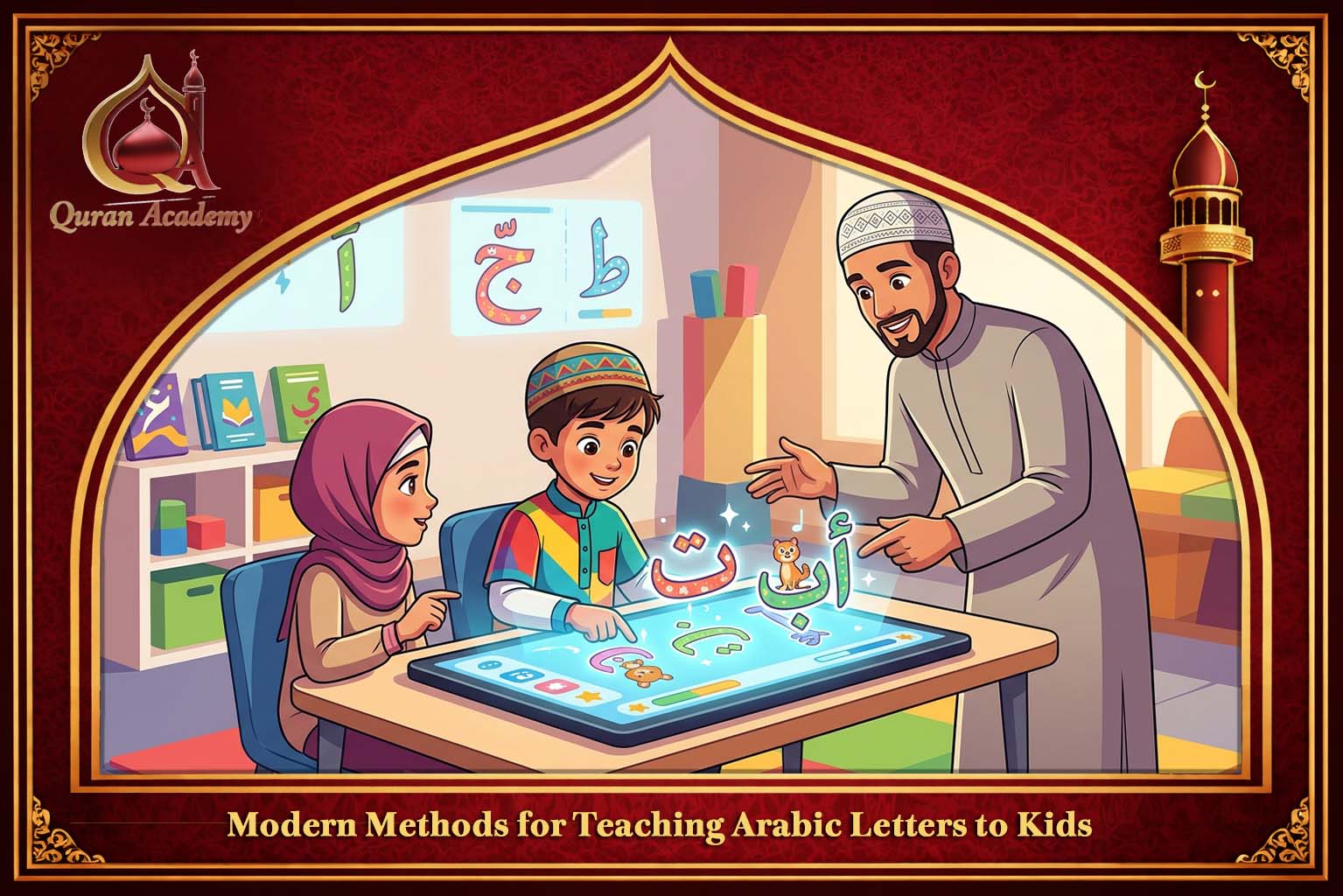
When taught correctly, Best online arabic classes for kids becomes more than a basic educational task; it turns into an engaging and enjoyable learning experience. Children begin to recognize Arabic letters with curiosity and confidence instead of confusion or hesitation, which makes the learning journey smoother and more effective.
Modern teaching methods focus on interaction, visual learning, and play-based activities that match how young minds naturally absorb information. Through songs, games, and hands-on practice, children connect letters with meaning and sound in a simple and memorable way.
This approach helps build a strong foundation in early language learning and encourages long-term interest in Arabic. The goal is not only memorization but also creating a positive emotional connection with the language that supports continuous growth and sustainable learning throughout a child’s development.
Frequently Asked Questions
provide quick answers to common queries, helping readers understand key points and find useful information easily.
1. What is the best age to start teaching Arabic letters to kids?
The ideal age is between 4 and 6 years old, but early auditory exposure can begin even earlier.
2. How long does it take for a child to learn Arabic letters?
It varies, but most children can recognize all letters within 2 to 4 months with consistent daily practice.
3. Can children learn Arabic letters without a teacher?
Yes, but structured programs like quran academy make the process faster, more accurate, and more engaging.
In conclusion, teaching Arabic letters to children is most effective when it is based on patience, consistency, and engaging learning activities.
Children learn best through play, repetition, and simple interactive methods that match their natural way of understanding. Instead of focusing on speed, the priority should be creating a positive and enjoyable learning environment.
This helps children recognize letters easily, build confidence, and develop a strong foundation in the Arabic language that supports their future reading and writing skills in a natural and sustainable way.