Tajweed for beginners in quran academy is an essential starting point for anyone who wants to recite the Quran correctly. Tajweed helps preserve the exact meaning and pronunciation of every word, ensuring accuracy and beauty in recitation.
At quran academy, beginners learn step by step how each letter should be pronounced from its correct place. This gradual learning makes the process easier and more effective.
Correct Tajweed improves focus, understanding, and spiritual connection during recitation. It also helps learners avoid mistakes that could change meanings.Ultimately, Tajweed is not just a set of rules, but a way to recite the Quran with respect, clarity, and devotion.
Tajweed for Beginners Basic Rules Guide
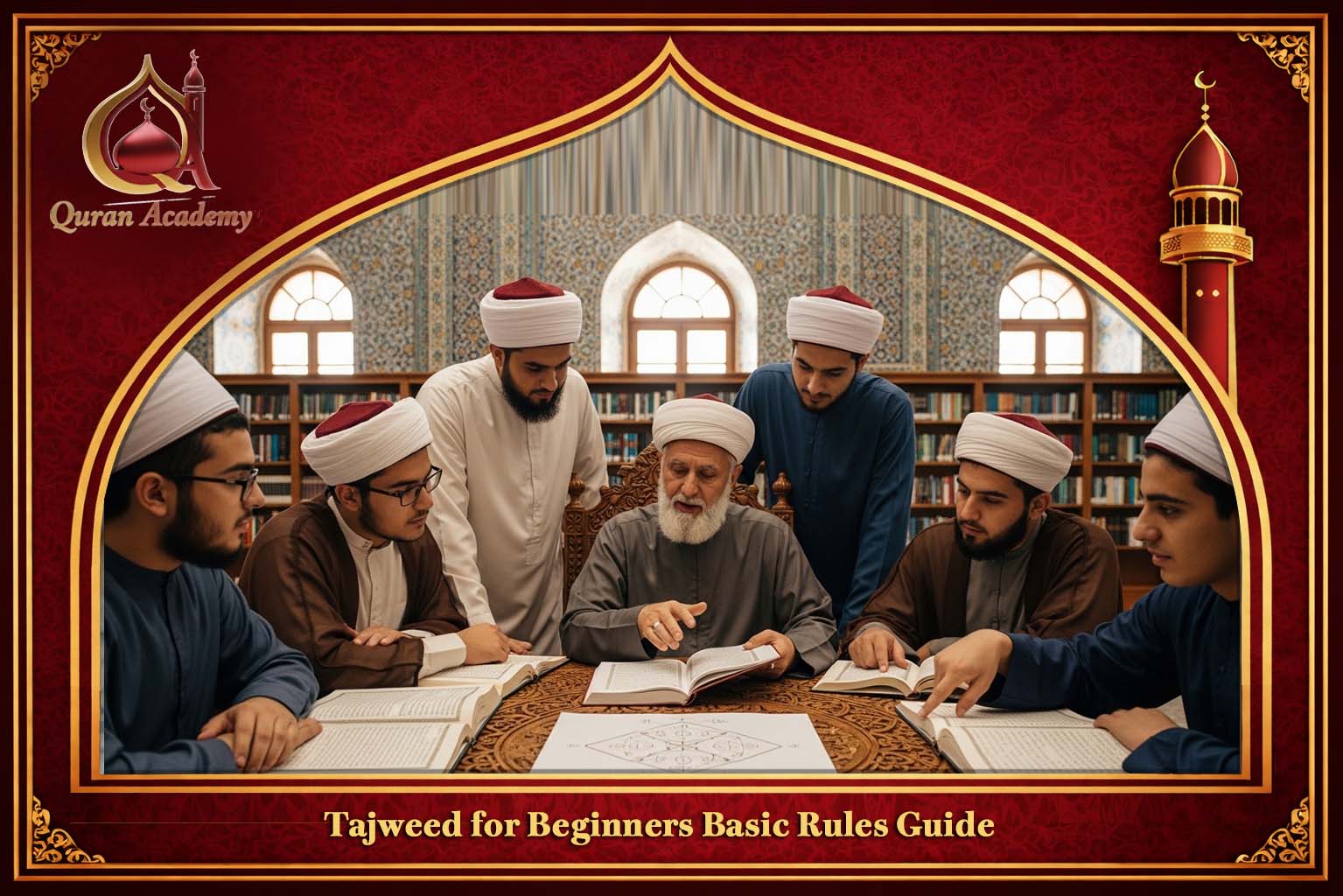
Learning to recite the Quran correctly is a meaningful journey that extends far beyond simple reading. It focuses on preserving the exact pronunciation, rhythm, and beauty of the divine message as it was revealed. For beginners, Tajweed rules may initially feel overwhelming; however, with a clear structure and gradual practice, the process becomes significantly easier and more natural over time.
This guide aims to help beginners understand the essential principles of tajweed for beginners in a clear, practical, and accessible manner. Rather than concentrating on memorization alone, it encourages learners to develop the ability to apply rules accurately during actual recitation. As a result, learners gradually gain both confidence and precision.
Moreover, the guide avoids unnecessary complexity and instead emphasizes real examples, straightforward explanations, and continuous application. Each rule is introduced within a practical context, which helps learners immediately understand when and how to use it during Quranic reading.
In addition, beginners are strongly encouraged to adopt patience and consistency. Although progress may seem slow at first, regular practice leads to steady improvement. Therefore, focusing on small daily efforts proves more effective than irregular intensive study sessions.
Online Quran Academy
An online Quran academy provides an accessible and flexible way for students around the world to learn the Quran from the comfort of their homes. Through modern technology, learners can connect with qualified teachers, receive live guidance, and improve their recitation step by step without the need for physical attendance.
At quran academy, students are offered structured lessons that focus on Tajweed, correct pronunciation, and gradual skill development. This approach allows learners of all ages to progress at their own pace while still receiving proper feedback and support. In addition, an online learning environment helps students stay consistent, practice regularly, and build confidence in their recitation.

Learn Quran Recitation with Basic Tajweed Rules
Tajweed refers to the structured system of rules that governs the correct pronunciation of Quranic words. These rules ensure that every letter receives its precise articulation, sound quality, and phonetic characteristic without distortion or error. Consequently, Tajweed preserves both the accuracy and the beauty of recitation.
Many beginners experience difficulty at the beginning because Arabic phonetics rely on articulation points that do not exist in many other languages. Each sound originates from a specific location in the mouth or throat, which requires careful training and repetition. However, once learners understand these foundational concepts, their recitation improves noticeably.
Furthermore, consistent practice plays a crucial role in overcoming early challenges. With time, learners begin to recite more smoothly, and reading the Quran becomes more natural and meaningful. Importantly, the process does not depend on speed; instead, it relies on patience, repetition, and gradual mastery.
In addition, listening to skilled reciters significantly enhances learning. It helps train the ear, improves pronunciation accuracy, and strengthens overall fluency. Therefore, combining listening with active practice produces the best results.
Ultimately, the core principle of quran tajweed online classes UK remains simple: every letter has a right, and every sound has a precise place. When learners respect this principle, their recitation becomes more accurate, beautiful, and spiritually enriching.
Noon Sakinah and Tanween Rules
One of the most essential areas in Tajweed involves the pronunciation of noon sakinah and tanween. These sounds change depending on the following letter, which creates four main rules.
1. Clear Pronunciation (Izhar)
When noon sakinah or tanween is followed by throat letters such as hamzah, ha, ayn, or kha, the sound is pronounced clearly without blending.
For example: from guidance
Here, the noon is articulated clearly.
2. Merging (Idgham)
When followed by specific letters like ya, ra, meem, lam, waw, and noon, the sound merges smoothly into the next letter.
For example: from their Lord
In this case, the sounds connect naturally.
3. Conversion (Iqlab)
When the next letter is “ba,” the noon sound transforms into a hidden meem sound.
For example: after that
This change occurs softly and subtly.
4. Hiding (Ikhfa)
When followed by certain letters, the noon sound becomes partially hidden while maintaining a nasal tone.
For example: under it
The sound remains between clear and merged.
Read also: learn arabic online
Meem Sakinah Rules
Meem sakinah rules are generally simpler, yet they remain essential for correct recitation.
1. Clear Pronunciation
When meem is followed by most letters, it is pronounced clearly with a nasal tone.
For example: for them therein
2. Hidden Pronunciation
When meem is followed by “ba,” the sound becomes slightly hidden with nasalization.
For example: they in the hereafter
3. Merging
When two meems occur consecutively, they are merged into a single meem with nasalization (ghunnah) held for two counts.
Read also:learn islam online
Madd (Elongation) Basics
Madd refers to the elongation of vowel sounds in Quranic recitation and represents one of its most distinctive features.
Natural Madd
This basic form extends the sound for exactly two counts.
Examples:
- he said
- they say
- it was said
Consistency is crucial here. Each elongation must remain equal in duration. However, beginners often rush or overextend sounds, so careful practice is necessary.
Read also:islamic classes for kids
Qalqalah (Echo Sound Rule)
Qalqalah applies to five letters: qaf, ta, ba, jeem, and dal. When these letters appear in a silent position or at the end of a word, they produce a light echoing effect.
Examples:
- father
- he calls
The sound should remain crisp and controlled. Therefore, it must not become exaggerated or heavy.
Read also:aqidah course online
Tafkheem and Tarqeeq
Arabic pronunciation includes both heavy and light articulation styles.
Heavy Letters
Such as: kh, s, d, gh, t, q, dh
These are pronounced with depth and fullness.
Light Letters
Most other letters fall into this category and are pronounced softly.
Although the difference may appear subtle, it significantly influences the beauty and accuracy of recitation.
Rules of Waqf (Stopping Rules)
Proper stopping ensures correct meaning and clarity during recitation.
Common symbols include:
- m: mandatory stop
- la: do not stop
- j: optional stop
- s: preferred stop
Incorrect stopping can alter meanings; therefore, careful attention is required.
Read also: tajweed rules explained
Daily Practice Method
Effective learning depends on consistency rather than duration.
A simple routine includes:
- reviewing letter sounds
- practicing one rule daily
- reading short verses slowly
In addition, recording and reviewing recitation helps identify mistakes early.
Read also:seerah course online
Common Mistakes
Beginners often:
- rush reading
- ignore articulation points
- mix rules too early
- neglect listening practice
However, awareness of these errors helps prevent long-term issues.
Learning Techniques
Several methods improve Tajweed learning:
- spaced repetition
- active application
- listening and imitation
- step-by-step learning
These strategies make the process smoother and more effective.

FAQ
This section answers the most common questions beginners have about Tajweed rules and Quran recitation. It helps clarify basic concepts and supports learners in applying what they study correctly.
1. How long does it take to learn basic Tajweed?
Most beginners need a few months of consistent daily practice to understand and apply basic rules correctly.
2. Can I learn Tajweed without a teacher?
Yes, you can start learning alone, but guidance from a qualified teacher greatly improves accuracy and prevents mistakes.
3. What is the best way to practice Tajweed daily?
The best method is short, consistent practice with listening, repetition, and gradual application of rules in real verses.
In conclusion, Tajweed for beginners in quran academy provides a clear and structured path for learning correct Quran recitation. It helps learners understand how to pronounce each letter properly while preserving the meaning and beauty of the Quran.
With consistent practice and gradual learning, beginners can steadily improve their accuracy and fluency. Tajweed is not only about following rules, but also about developing respect, focus, and a deeper spiritual connection with the words of Allah.
Learn also: